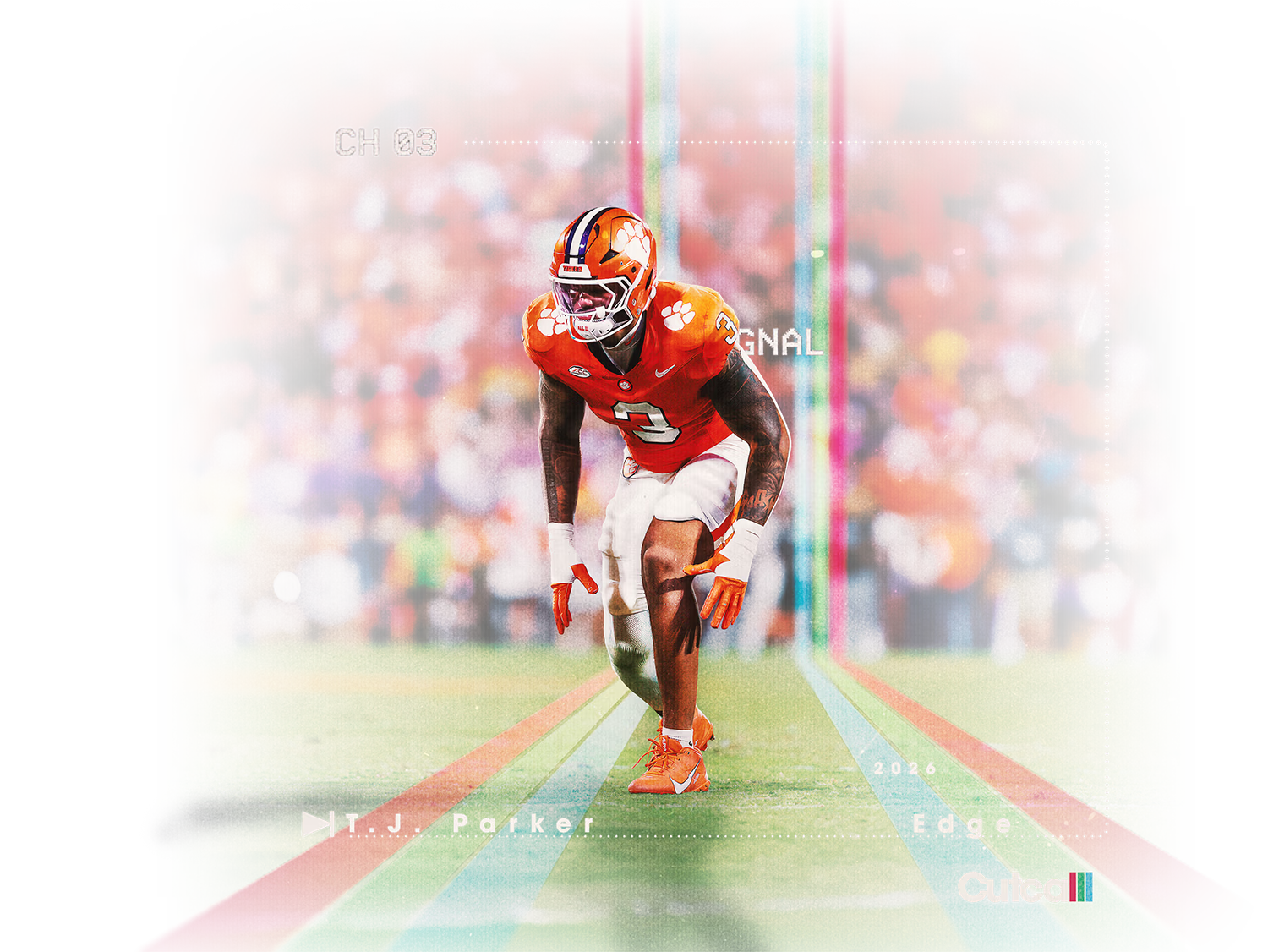


Height: 6-3 | Weight: 265 | Class: Junior | School: Clemson
Position: ED | Draft: 2026 | Red | Rank: 28
2025: 41 press • 6 sacks • 5 TFL | 2024: 43 press • 11 sacks • 5 TFL
Overview
TJ Parker entered the 2024 season already established as one of the most productive and disruptive edge defenders in college football, finishing the year with 12 sacks and 51 pressures across a full 14-game schedule. That breakout campaign vaulted him into early top-five draft conversations and cemented his reputation as a high-impact front-seven player. His 2025 production dipped on the surface — 6 sacks and 41 pressures in 12 games — but the gap is far narrower than the discourse suggests, especially when viewed through usage, alignment, and responsibility. Rather than regressing, Parker’s role expanded, and his tape became more complete.
Technically, Parker is one of the most refined edge defenders in the class. He consistently attacks the top of the tackle’s arc and makes a habit of targeting the outside shoulder, forcing offensive tackles to commit early. His best pass-rush weapon is a violent double swipe, but he layers in effective stab–rip combinations and a bull rush built on leverage rather than momentum. When he converts speed to power, it is timed and deliberate — he wins underneath pads, gets into the chest, and can physically lift tackles out of their posture. His hand usage is dominant throughout the rep, and what separates him further is his diagnostic ability: his eyes live in the backfield, and he routinely disengages to make down-saving stops once quarterbacks or runners declare. Against the run, Parker is exceptionally well anchored on the edge, able to absorb contact without losing contain integrity.
Usage-wise, Clemson’s defensive shift under Tom Allen in 2025 asked more of Parker. He was moved around the front, dropped into coverage more frequently, and deployed inside on late downs, where his processing and leverage translated immediately. Those responsibilities muted some raw sack totals but showcased a defender who can be trusted in multiple roles without sacrificing effectiveness.
Athletic profile
Parker owns a prototypical edge build with legitimate size, long arms, and a dense, powerful frame that carries strength without stiffness. His movement skills are balanced and controlled rather than loose, allowing him to stay centered through contact and redirect without losing momentum. While he may not profile as a niche speed rusher, his burst is more than sufficient, and his power generation is among the best in the class.
His grip strength and torso power stand out on tape, particularly when engaging doubles or compressing pockets from reduced alignments. Parker’s athletic profile fits cleanly into NFL structures that value versatility over specialization. He projects best as a base 4–3 edge or a do-it-all 3–4 outside linebacker capable of reducing inside on passing downs, rather than a pure wide-nine specialist who lives exclusively on the arc.
Weaknesses / Areas to Improve
- Pass-rush production may undersell his impact to teams prioritizing sack totals.
- Does not possess elite bend traits associated with pure speed rushers.
- Wins more through force and processing than suddenness, which can be misread in isolation.
- Expanded coverage usage limits pure rush volume in certain defensive structures.
Weaknesses / Areas to Improve
- Pass-rush production may undersell his impact to teams prioritizing sack totals.
- Does not possess elite bend traits associated with pure speed rushers.
- Wins more through force and processing than suddenness, which can be misread in isolation.
- Expanded coverage usage limits pure rush volume in certain defensive structures.
Draft projection
I assign TJ Parker a Red Chip grade, with his board placement fluctuating between EDGE3 and EDGE5 depending on positional weighting. League consensus may push him into the 15–35 range, with some boards stretching him toward the early second round, but the tape supports first-round value. He should contribute immediately as a rotational edge with early-down responsibility, and his ability to reduce inside gives him a clear path to expanded usage. Over the early portion of his rookie contract, Parker profiles as a dependable, high-impact front defender whose value compounds as responsibilities increase.
prospect comp • Harold Landry III
system fit • 4–3 base fronts or flexible 3–4 schemes valuing edge discipline, interior reduction, and high diagnostic defenders